
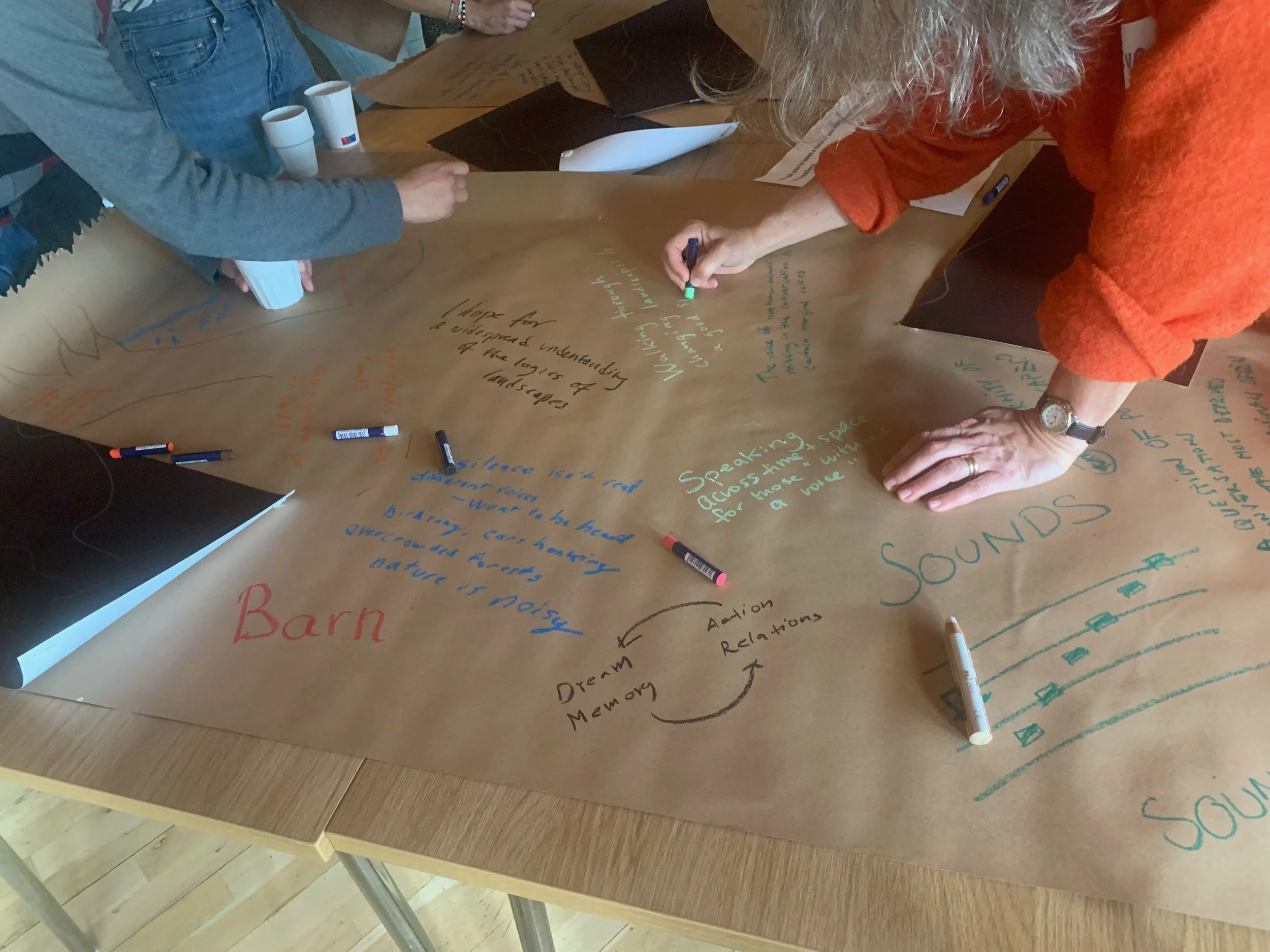
Great summary of the Summer School here : https://www.kth.se/anthropocenehistory/news/summer-school-in-time-and-sustainability-2026-1.1484737
EVENT COMPLETED
Dates:
27th May (afternoon) online
2 - 5th June face to face, Stockholm and Uppsala (see details below)
AIM
The workshop will offer students tools to explore how different ideas of time, different rhythms and different assumptions about time and change are at play in their own and adjacent research areas – and to better understand the consequences of different timings for questions of power, justice, inequalities and the possibility of sustainable transformations.
This workshop will help students to engage with temporal questions in relation to their own research, support them to better understand the competing time frames and rhythms of different disciplines and decision-making practices, and position them well to develop collaboration across disciplines in future – a key factor in the development of their research careers.
BACKGROUND
Achieving sustainable transformations is an interdisciplinary challenge demanding both scientific and social scientific expertise. Ecologists and climate scientists will need to work and act alongside political scientists, anthropologists, sociologists and environmental communications specialists if they are to achieve the sorts of social and practical changes needed to protect and regenerate thriving ecosystems. Despite this, students from all fields rarely get a chance to work in a sustained fashion alongside those from different disciplines.
This workshop will create an exciting interdisciplinary learning community bringing together students from Ecology and Environmental Communications/Humanities with those working in adjacent fields from across Swedish Universities. They will come together to address a rapidly growing new research topic that is becoming critically important across sustainability debates in all disciplines: the question of TIME.
While spatial differences are well understood in the field of sustainability transitions, it is only recently that attention is being given to how time – more specifically, how different time frames, timing mechanisms, timing processes, time measures, rhythms and temporal narratives – influence both research and political decisions in the field of sustainability. Indeed, despite the fact that key sustainability conflicts are characterised by temporal conflicts – the mismatch between ecological and political time frames, the divergence in plant and pollinator timing as a result of climate change - temporal questions are far from standard in Ecology and Environmental Communication/Humanities. This matters because timing decisions have the potential to create significant negative impacts for those whose voices are rarely heard – the ecosystems whose existence is threatened and the marginalised communities whose livelihoods are at stake.
This new topic, which is rapidly developing internationally, is therefore particularly relevant to students who have an interest in how conflicts and tensions arise in sustainability debates and how these might be addressed in new ways. It will be of significant interest to those whose research engages with stakeholders – such as municipalities, industry partners, policy makers, community activists, farmers, citizen scientists – as well as living ecologies – soils, land, water, insects, animals.
General Structure
The workshop will include:
- Personal reading and preparation
- Initial ice breaker / warm up online sessions to orientate everyone to the topic
- 2 days of hands-on and inclusive workshops, using engaging game based and creative methods to exploring key themes of time and sustainability and developing students’ theoretical and practical knowledge to work in this area.
- 1 day of individual work, using the lessons from the workshops to interrogate and develop their own research project.
- 1 day of presentations and group work – showcasing the temporal aspects of individual studies, finding points of connection between them, identifying the potential for future collaboration.
Dates
The workshop will run over 5 days, with 3 face to face tutor-led sessions, one online/self-directed study day, one self-directed group activity day.
May 27th (online), June 2nd (on campus, KTH Stockholm), June 3rd (on campus SLU, Uppsala), June 4th (self-organised, on campus, SLU Uppsala), June 5th (on campus)
Learning targets
The workshop will help students to:
Interrogate and understand how temporal assumptions shape their own practices and their discipline’s approach to research
Use diverse tools to notice and make visible competing human and multi-species temporalities at play in sustainability transitions and transformations
Support participants to critically reflect on the way that timing mechanisms and practices inform academic and social debates about sustainability issues
Consider how to work creatively with a repertoire of tools to diagnose how time is at play in your own research study and open up new areas for working with time in your own research.
Become comfortable and familiar with working in interdisciplinary teams, recognising and learning from diverse perspectives and methods.
Organisers
The workshop is organised under the August T Larsson Guest Professorship at SLU. It will be led by Professor Keri Facer (Bristol University) and Dr Harriet Hand (Bristol University), supported by Prof Åsa Berggren. The workshop will also benefit from the assistance of Dr Sanna Barrineau (Uppsala University), Dr Anne-Kathrin Peters (KTH) and Dr Lakin Anderson (KTH) who specialise in sustainability education and transformations.
Preparation
Pre-listening for the course: The Temporal Imagination Podcast (Apple Podcasts or Youtube) https://www.temporalimagination.org/
Pre-reading will be shared after sign-up
Participants Students are welcome to apply to join from any discipline concerned with sustainability transformations. There will be up to 15 spaces for PhD students with 5 reserved for Ecology students. No prior knowledge of time/temporality questions required.
Credits 1.5 ECS
Accreditation
Attendance on all 5 days and active participation in group discussions.
Contributing one concept/word/example to the collective glossary
Contribution to the joint presentation on day 5
There will be an expectation to listen to one podcast and read two documents before attending the course and to participate in group dialogues and presentations throughout the three days.
Applying for the programme
Students should write a 500-word application (Word doc please) to join the doctoral school, outlining their current research projects in 200 words and explaining in 300 words, what draws them to this topic and to the interdisciplinary nature of the workshop. Applicants should clarify if they wish to submit the essay and gain 3 credits or just attend and participate in the programme. Applications should be submitted to BOTH Keri Facer and Åsa Berggren by May 6th. Email Keri.Facer@bristol.ac.uk and Asa.Berggren@slu.se
Acknowledgements
This summer school is supported by the Society for Transformative Conversations, the August T Larsson Guest Professorship at SLU, the British Academy Times of a Just Transition Programme, and the Centre for Anthropocene History, KTH